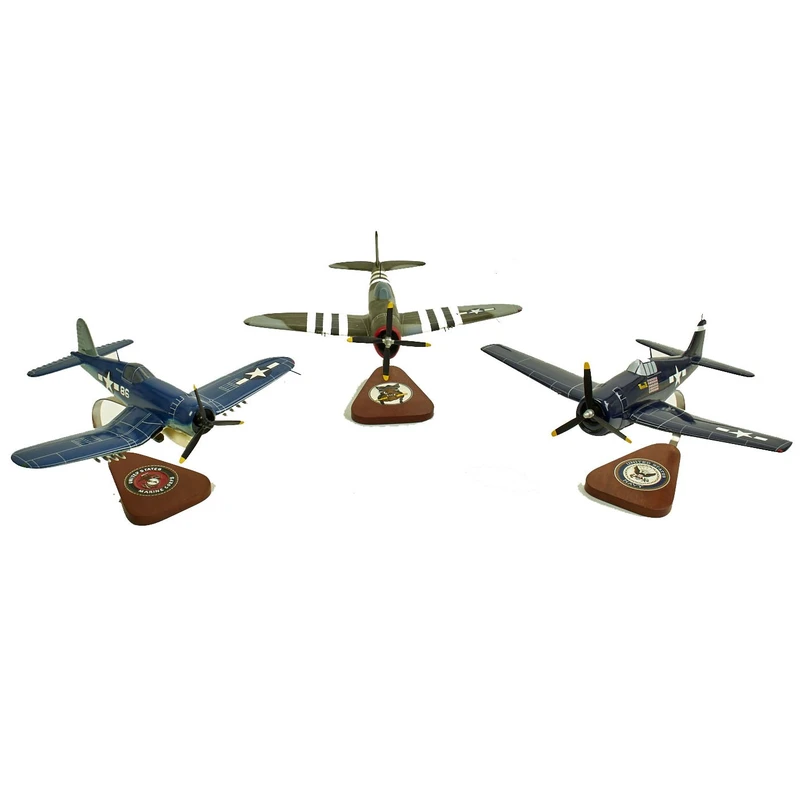
WWII Wood 1/24 Model Airplane Collection – Grumman F6F Hellcat, Vought F4U Corsair, Republic P-47 Thunderbolt
Original price was: $56.00.$34.18Current price is: $34.18.
Description
Newly Made Items: This is a collection of five World War Two 1/24 scale models original sold by the now out of business warplanes.com. This company manufactured very high quality wood model aircraft for serious aviation model collectors and enthusiasts. This collection of 3 model airplanes are all offered in excellent condition and are as follows:
– The Grumman F6F Hellcat is an American carrier-based fighter aircraft of World War II. Designed to replace the earlier F4F Wildcat and to counter the Japanese Mitsubishi A6M Zero, it was the United States Navy’s dominant fighter in the second half of the Pacific War, outdueling the faster Vought F4U Corsair, which had problems with carrier landings. Powered by a 2,000 hp (1,500 kW) Pratt & Whitney R-2800 Double Wasp, the same powerplant used for both the Corsair and the United States Army Air Forces (USAAF) Republic P-47 Thunderbolt fighters, the F6F was an entirely new design, but it still resembled the Wildcat in many ways. Some military observers tagged the Hellcat as the ”Wildcat’s big brother”. The F6F made its combat debut in September 1943, and was best known for its role as a rugged, well-designed carrier fighter, which was able to outperform the A6M Zero and help secure air superiority over the Pacific theater. A total of 12,275 were built in just over two years. Hellcats were credited with destroying a total of 5,223 enemy aircraft while in service with the U.S. Navy, U.S. Marine Corps, and Royal Navy Fleet Air Arm. This was more than any other Allied naval aircraft.[9] Postwar, the Hellcat was phased out of front-line service, but remained in service as late as 1954 as a night fighter.
– The Vought F4U Corsair is an American fighter aircraft that saw service primarily in World War II and the Korean War. Designed and initially manufactured by Chance Vought, the Corsair was soon in great demand; additional production contracts were given to Goodyear, whose Corsairs were designated FG, and Brewster, designated F3A. The Corsair was designed and operated as a carrier-based aircraft, and entered service in large numbers with the U.S. Navy in late 1944 and early 1945. It quickly became one of the most capable carrier-based fighter-bombers of World War II.[2] Some Japanese pilots regarded it as the most formidable American fighter of World War II and its naval aviators achieved an 11:1 kill ratio. Early problems with carrier landings and logistics led to it being eclipsed as the dominant carrier-based fighter by the Grumman F6F Hellcat, powered by the same Double Wasp engine first flown on the Corsair’s first prototype in 1940. Instead, the Corsair’s early deployment was to land-based squadrons of the U.S. Marine Corps and U.S. Navy. The Corsair served almost exclusively as a fighter-bomber throughout the Korean War and during the French colonial wars in Indochina and Algeria. In addition to its use by the U.S. and British, the Corsair was also used by the Royal New Zealand Air Force, French Naval Aviation, and other air forces until the 1960s. From the first prototype delivery to the U.S. Navy in 1940, to final delivery in 1953 to the French, 12,571 F4U Corsairs were manufactured[8] in 16 separate models. Its 1942–1953 production run was the longest of any U.S. piston-engined fighter.
– The Republic P-47 Thunderbolt is a World War II-era fighter aircraft produced by the American aerospace company Republic Aviation from 1941 through 1945. Its primary armament was eight .50-caliber machine guns, and in the fighter-bomber ground-attack role it could carry five-inch rockets or a bomb load of 2,500 lb (1,100 kg). When fully loaded, the P-47 weighed up to eight tons, making it one of the heaviest fighters of the war.
The Thunderbolt was effective as a short-to medium-range escort fighter in high-altitude air-to-air combat and ground attack in both the European and Pacific theaters. The P-47 was designed around the powerful Pratt & Whitney R-2800 Double Wasp 18-cylinder radial engine, which also powered two U.S. Navy/U.S. Marine Corps fighters, the Grumman F6F Hellcat and the Vought F4U Corsair.
The P-47 was one of the main United States Army Air Forces (USAAF) fighters of World War II, and also served with other Allied air forces, including those of France, the United Kingdom, and the Soviet Union. Mexican and Brazilian squadrons fighting alongside the USAAF also flew the P-47.
The armored cockpit was relatively roomy and comfortable and the bubble canopy introduced on the P-47D offered good visibility. Nicknamed the ”Jug” owing to its appearance if stood on its nose, the P-47 was noted for its firepower, as well as its ability to resist battle damage and remain airworthy. A present-day U.S. ground-attack aircraft, the Fairchild Republic A-10 Thunderbolt II, takes its name from the P-47.
Related products
-
Original German WWII Luftwaffe Gold Grade Front Flying Clasp for Bombers & Dive Bombers (Kampf & Sturzkampfflieger)
Original price was: $79.20.$44.09Current price is: $44.09. -
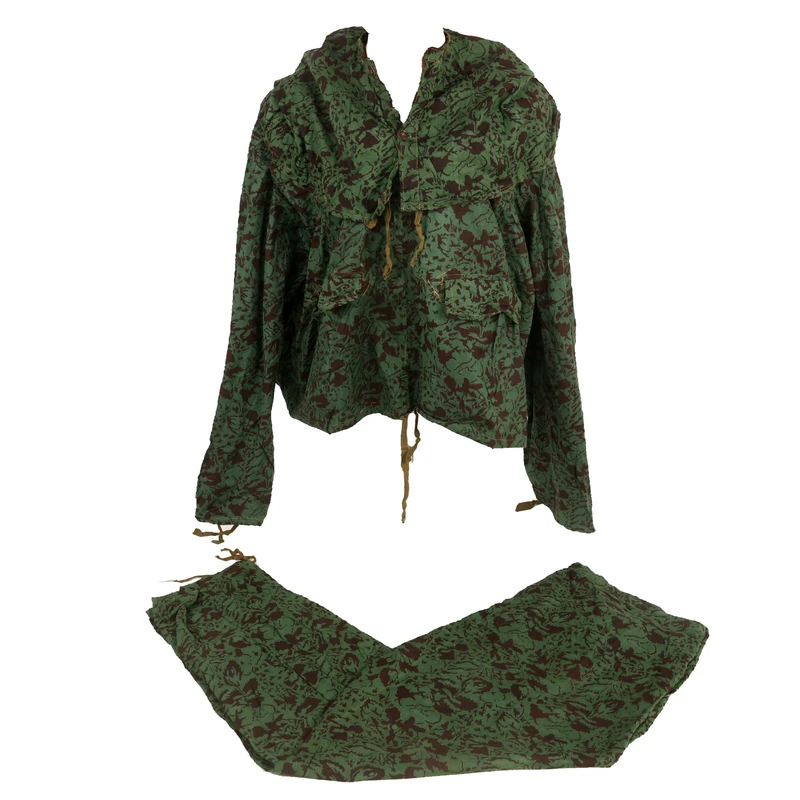
Original Romania Cold War Era Circa 1960s “Inverse Leaf” Camouflage Sniper Smock with Trousers – No Romanian Markings
Original price was: $79.20.$53.06Current price is: $53.06. -
Original Japanese WWII Large Hand Painted Cotton Good Luck Flag dated December 20, 1938 – 55 ” × 84 ½”
Original price was: $79.20.$42.84Current price is: $42.84. -
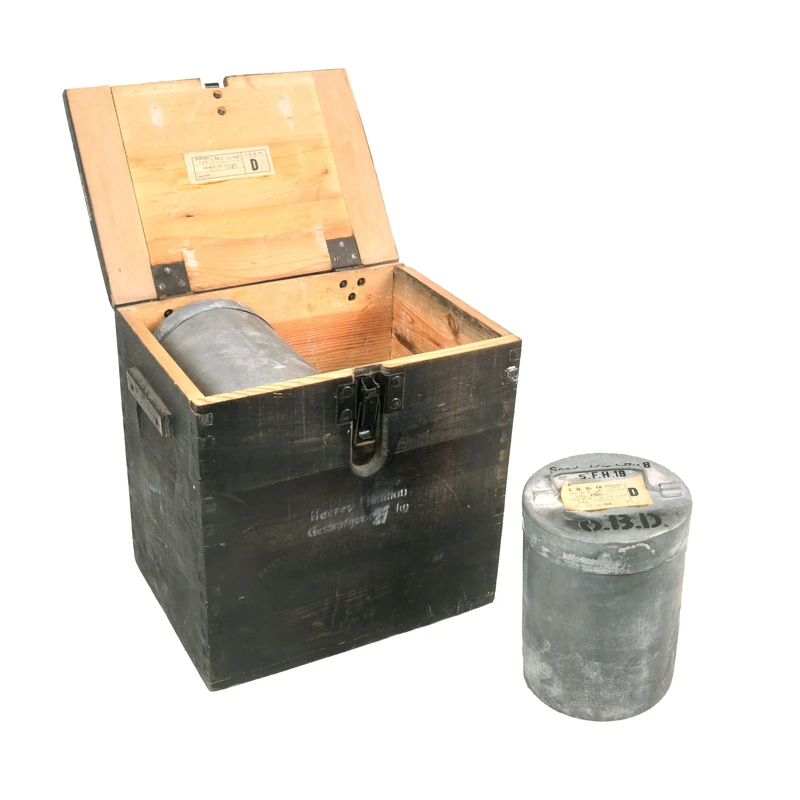
Original German WWII 10.5cm leFH 18 Light Field Howitzer Propellent Crate with Steel Canisters – Dated 1944
Original price was: $63.20.$45.56Current price is: $45.56. -
Original U.S. WWII Named US Navy Patrol Bombing Squadron (VB later renamed VPB)-104 G-1 Leather Flying Jacket – M. Kusenda USNR
Original price was: $239.99.$179.14Current price is: $179.14. -
Original German WWII NSDAP National Political Eight Pennant Strand Banner – 104 ” x 15 “
Original price was: $79.20.$52.84Current price is: $52.84. -
Original U.S. WWII Italian POW Made M4 Sherman Tank Wood Desktop Cigarette Tobacco Box – Formerly A.A.F. Tank Museum Collection
Original price was: $35.00.$27.30Current price is: $27.30. -
Original Belgian Cuirassier Cavalry Model 1845 Helmet with Lion Front Plate and Original Plume
Original price was: $239.20.$161.16Current price is: $161.16.